Financial services have no shortage of data. Banks, lenders, and other financial institutions work with loan agreements, credit policies, KYC documents, procedure manuals, audit records, regulatory material and all the rest, i.e., thousands of critical documents.
But the real challenge is much more basic: finding the right piece of information and being able to trust the answer received. That matters even more as AI moves deeper into financial-services workflows.
PwC’s 2025 financial services survey found that a whopping 55% of banking executives view GenAI or agentic AI as their top priority to invest in over the next few years, and a further 58% think it is going to be a total gamechanger in the next 3 years.
But just getting answers quicker isn’t going to be enough for an industry where decisions are based on tiny specific details such as single clause, policy requirement, rate, covenant, or regulatory provision.
Why Traceability Matters in Financial Services
Consider a credit team reviewing a loan agreement. When they ask a question like “What covenants apply to this facility?”, you would expect a straightforward answer. But what the financial services team needs is a lot more details. So, it is not just about a sentence that an AI generates. The reviewer may also need to know:
- Which document contains the answer?
- Which section supports it?
- What page should be checked?
- Is the answer based on the latest version?
- Can the finding be verified before it is used?
This is where traceable AI becomes far more important.
The kind of AI system that gives you an answer without showing you where it came from might make information retrieval a bit faster, but it is still going to leave the verification work to the employee. On the other hand, a system that shows you where that answer came from can make the whole review process a lot more transparent. That distinction becomes especially important as institutions move AI from the testing phase into operational workflows.
Bring Source-Level Traceability into Your Financial Workflows
Give your teams a faster way to find, extract, compare, and verify information across loan files, policies, procedures, and other financial documents.
AI Adoption Is Moving into Document-Heavy Work
It is not just in customer-facing applications that the potential for AI is being explored. Financial institutions also have large volumes of manual, document-heavy processes that are ripe for AI-driven automation.
Deloitte notes that this is an area where generative AI really shines, helping with document processing across lending, onboarding, compliance, claims and customer servicing; all the things that involve sifting through all sorts of documents for things like classification, extraction, validation, and routing.
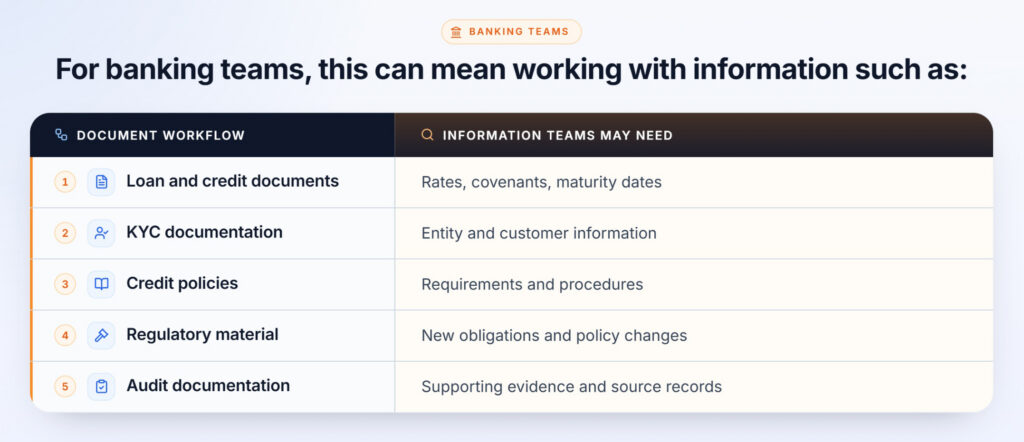
The difficulty is that this information often sits inside unstructured documents rather than a clean database field. Teams may need to open multiple PDFs, search through lengthy agreements, compare versions, or manually transfer findings into spreadsheets.
AI can reduce that burden. But in financial services, the quality of the answer and the ability to verify it need to go together.
The Gap Between AI Answers and AI You Can Verify
This is also where the whole idea of responsible AI starts to become important.
McKinsey’s 2026 AI Trust Maturity Survey found that while responsible-AI maturity is improving, strategy, governance, and agentic-AI controls continue to lag, with only about 30% of organizations reaching maturity level three or higher in those dimensions.
For financial services, that raises a practical question: What should a business do when an AI system comes up with an answer that ends up influencing a business process? Certainly, we need AI systems that give answers that don’t just leave employees blindly trusting the model. We need verification to be a natural part of the workflow.
That means moving beyond: Question → AI answer
toward: Question → AI answer → Source → Verification
What Traceable AI Looks Like in Practice
For example, a lending analyst might ask a question like: “What are the maturity dates and key covenants across these credit agreements?”
Rather than having to manually open each document one by one, the system could figure out the relevant information, lay it out in a neat and tidy format, and even provide citations back to the source documents.
The same approach can support other banking workflows.
A compliance team could compare internal policies to whatever new regulations have just come out. A credit team could check how a loan agreement has changed between its different versions. An audit team could track supporting evidence across documentation. A risk team could hunt down procedure manuals or historical records without having to manually review every single page.
Where OpenParser AI Adds Value for Financial Services Teams
OpenParser AI is built around this idea of grounded, verifiable document intelligence.
Teams can ask questions across connected documents and receive answers with citations pointing back to the exact source. The platform also provides 20+ purpose-built AI Agents for tasks such as document Q&A, document comparison, compliance checks, and structured extraction. For financial services teams, that creates a practical workflow: Find the information → understand it → extract what matters → verify the source → use the result.
At the end of the day, the value is not simply reducing the time spent searching. It is making document-heavy work easier to review, easier to validate, and easier to act on.
Bring Source-Level Traceability into Your Financial Workflows
Give your teams a faster way to find, extract, compare, and verify information across loan files, policies, procedures, and other financial documents.
Frequently Asked Questions
1. What is traceable AI in financial services?
Traceable AI provides an answer along with a clear reference to the source information, so users can verify the result.
2. Why are citations important for banking AI?
Citations help teams validate answers against the original document, which is especially useful for compliance, lending, audit, and risk workflows.
3. Can AI help banks work with unstructured documents?
Yes. AI-powered document processing can classify, extract, compare, and retrieve information from document-heavy workflows such as lending, KYC, compliance, and audit.
4. How does OpenParser AI support financial services teams?
OpenParser AI provides cited document Q&A, structured extraction, document comparison, compliance checking, and purpose-built AI Agents for document-heavy workflows.