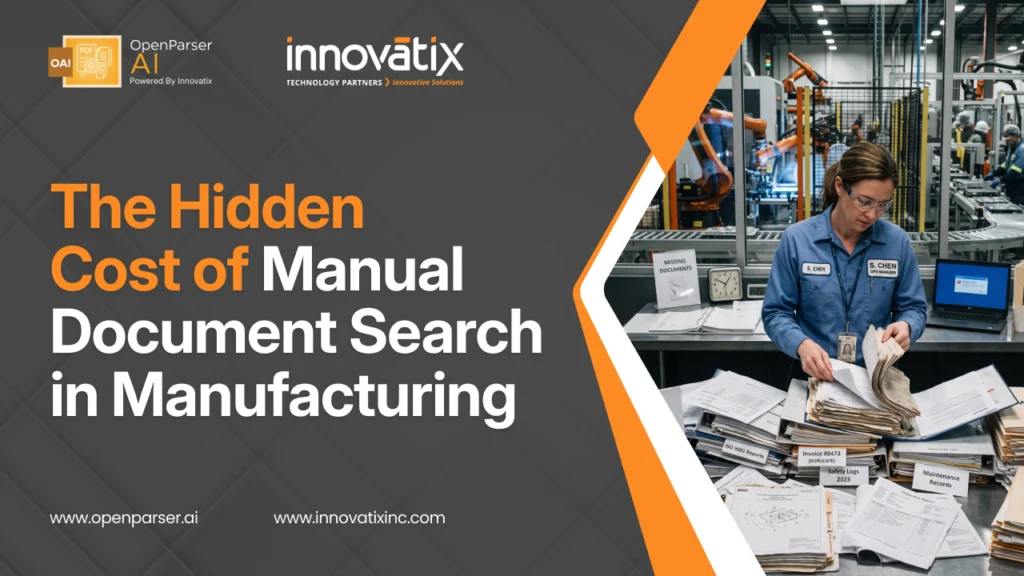
A production line doesn’t come to a halt due to a missing document. More often, it stops because the right document isn’t available when it is needed.
Let’s take an example of a maintenance technician addressing a machine failure. Before restarting the equipment, they need the latest maintenance manual. Meanwhile, the quality team awaits the latest revision of the inspection checklist, while engineering requires the most recent drawing revision to verify a design change. The information is already in place, but it is fragmented and stored in shared folders, email attachments and various systems.
On their own, these delays may appear insignificant. However, in a full manufacturing operation, they can cause delays, downtime and unnecessary rework.
Whether it is standard operating procedures (SOPs), engineering drawings, quality records, safety specifications, compliance documentation, or any other documents, manufacturing organizations rely on thousands of operational documents each day. These records continue to grow and document management becomes more than an administrative task.
It is a challenge that happens more often than many organizations realize. In 2023, a study by SME and Laserfiche found that manufacturers continue to heavily depend on manual processes, and 62% of manufacturers report delays in work due to manufacturing throughput, equipment effectiveness and capacity utilization. At the same time, document management remains one of the top technology investment priorities for manufacturers.
Why Manual Document Search Slows Manufacturing Operations
Getting the right information allows manufacturing teams to keep going. Whether it is a work instruction, an engineering drawing or a maintenance manual, each document will make sure that the right process is carried out at the appropriate time.
The challenge begins when that information is located in multiple locations.
One team has documents in a shared drive. The other uses e-mail attachments. Engineering uses one system, while quality maintains records in another. When someone requires the latest revision of a document, they may waste precious time looking through folders, comparing versions or asking others before they can move forward.
This does not only impact productivity. It impacts the whole business. For example, an incorrect or outdated work Instruction could lead to production problems. If a drawing revision is lost, it will slow down a design change.
With manufacturing becoming increasingly connected, a mere repository of documents is not sufficient. Teams must have quick access to relevant information, the most current approved version, and trust that they are working from a trusted source.
The Operational Cost No One Calculates
Manufacturers pay close attention to production metrics like the machine’s uptime, cycle time and overall equipment effectiveness (OEE). But, there is one thing that is often overlooked: the time employees spend looking for the right document before work can begin.
It may only take a few minutes to find the most up-to-date work instruction or check the revision of an engineering drawing. But with operators, maintenance engineers, quality inspectors and production supervisors doing the same process each day, those minutes can really add up.
In fact, the consequences of manual document searching go well beyond just getting the right document. A few of these impacts are listed below:
- Production delays while teams wait around for the latest approved documentation.
- Having to rework because the work instructions or drawing revisions are outdated.
- Equipment downtime due to maintenance manuals that aren’t instantly available.
- Slow going with customer and regulatory audits due to time spent gathering records.
- Productivity taking a hit when experienced employees are spending their time answering routine questions about where to find the documents instead of focusing on higher-value work.
Access 10,000+ Manufacturing Documents in Under 2 Seconds
OpenParser AI helps your teams find answers with citation-backed responses, so work doesn’t stop while teams search for documents.
How AI Is Transforming Manufacturing Document Workflows
Manufacturers don’t need another platform to store their documents. They need an easier way to use all the knowledge that is already floating around their operations. This is where AI-powered document intelligence is changing the way manufacturing teams work.
No more having to manually open folders, trying to remember the name of some file or checking through countless versions of the same document – teams can just fire off a question and get the answer in a flash.
Take this for example, instead of sifting through multiple files looking for what they need, teams can just ask:
- Which is the latest approved work instruction for Assembly Line 3?
- Show the maintenance procedure for this equipment.
- What changed between Revision B and Revision C of this engineering drawing?
- Does this SOP comply with the latest ISO requirements?
- Which supplier quality documents are required for the upcoming audit?
OpenParser AI brings these workflows together through its built-in AI Agent. Instead of just serving up a list of potential documents, it gets what you are asking, searches through all that manufacturing documentation, and gives you answers backed up by citations that point to specific pages.
This means engineers, maintenance teams, and quality managers can actually verify where the information came from before they do anything with it. This is especially valuable in manufacturing, where accuracy, traceability, and version control all have a direct impact on production and meeting all the compliance requirements.
Manufacturing teams can use OpenParser AI to:
- Query maintenance manuals and safety specifications.
- Extract part numbers and tolerances from specification sheets.
- Audit SOPs against ISO and OSHA standards.
- Compare engineering drawing revisions.
- Build supplier quality evidence packages for customer and regulatory audits.
Wrapping Up
As operations get more tangled up, it is getting harder to rely on searching through stacks of documents one by one. That is exactly why manufacturers are looking to break free from traditional ways of storing documents. They need solutions that help teams pull up the right information fast, check it against the original source, and then make decisions they can be confident in.
OpenParser AI is at the forefront of this change with its AI-powered document intelligence. Its built-in AI tool can understand questions across manufacturing documents, and then comes back with the answers – and not just any answers, answers with page-level citations to back them up, so teams can trust what they are working with.
From maintenance manuals and engineering drawings to quality check records and all the compliance documents, OpenParser AI helps manufacturers by turning all those scattered documents into useful knowledge that teams can actually use on the floor.
Nevertheless, in modern manufacturing, the difference between staying on schedule and falling behind isn’t always the equipment on the production floor. Sometimes, it is how quickly your teams can access the information they already have.
Access 10,000+ Manufacturing Documents in Under 2 Seconds
OpenParser AI helps your teams find answers with citation-backed responses, so work doesn’t stop while teams search for documents.
Frequently Asked Questions
1. How can AI improve manufacturing document management?
AI-powered document intelligence enables teams to search manufacturing documents using natural language instead of manually browsing folders or searching filenames. This reduces the time spent locating information and helps teams access the latest approved documentation more efficiently.
2. What types of manufacturing documents can OpenParser AI search?
OpenParser AI can work across a wide range of manufacturing documents, including maintenance manuals, engineering drawings, work instructions, SOPs, inspection reports, quality records, supplier documentation, safety specifications, compliance documents – the list goes on and on.
3. Why are citation-backed answers important for manufacturing teams?
Manufacturing decisions often rely on accurate and verifiable information. Citation-backed answers allow engineers, quality teams and maintenance personnel to trace every response back to the original document, helping them validate information before acting on it.
4. Can OpenParser AI compare different versions of engineering documents?
Yes. OpenParser AI can compare different versions of engineering drawings, specifications and other manufacturing documents to identify changes more quickly, helping teams review revisions with greater confidence. This aligns with manufacturing workflows such as comparing drawing revisions and supporting supplier quality evidence.