
Commercial lease portfolios contain some of the most valuable information a real estate organization manages. Rent schedules, escalation clauses, renewal options, termination rights and all the key notice dates that influence day-to-day decisions…it’s all in there.
The problem is that information just isn’t lying around in a simple, easily accessible format. It is scattered all over the place in lengthy lease agreements, amendments, addenda, and exhibits. Before teams can use that information, someone has to find it, interpret it, and enter it into a structured format that makes sense.
Basically, this process is known as commercial lease abstraction.
For one lease, it is a doable task. But when a portfolio contains hundreds or thousands of leases, manual abstraction starts to become a massive, hidden operational burden.
The scale of lease administration makes it clear why having access to lease information should be a priority. CBRE alone handles something like 300,000 lease interests every year and is responsible for overseeing a staggering $24.5 billion in rent payments annually for its clients. At that level, the idea of manually searching through individual documents just isn’t a feasible way to access portfolio knowledge.
What Manual Lease Abstraction Really Involves
Lease abstraction is the process of extracting important business and legal terms from a commercial lease and getting them all organized into a structured summary or set of data you can work with.
Needless to say, the specific information you need to capture can vary depending on the needs of your portfolio. Here are some of the key things you might want to look at:
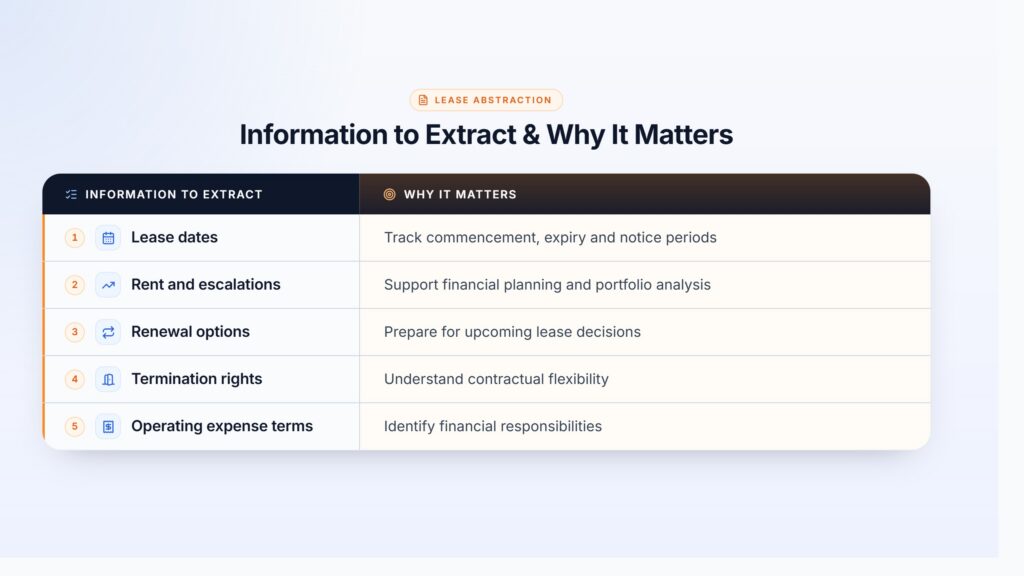
The thing is, though, a lease by itself doesn’t tell the whole story on its own. When you start factoring in amendments, you can see how rent is being changed, how the lease term gets extended, and how existing rights and obligations get modified.
So, an accurate abstract of the lease isn’t just about reading the lease itself, you need to review that alongside multiple related documents and figure out which terms are in effect right now.
The Hidden Costs of Manual Lease Abstraction
The obvious upfront cost is time but the impact of doing all this manual work goes way beyond just the hours spent reading documents.
Repetitive Review and Data Entry
Teams constantly find themselves stuck in a vicious cycle: opening the same old document, sifting through clauses to try and find the information, making sense of it all and then entering that information into a spreadsheet or system.
Amendments Add Another Layer of Complexity
A later amendment might override and change the whole dynamics. Reconciling all the different versions of the lease manually is like trying to untangle a knot and then you have just got to make absolutely sure that your abstract catches up with the current terms.
Portfolio Visibility Becomes Harder
When important details are trapped inside individual documents, trying to get a handle on a high-level question like “which leases need renewal notices this quarter?” can be more like searching for a needle in a haystack. The answer is certainly floating around in the portfolio somewhere, but it isn’t immediately usable until someone extracts and organizes it.
This matters because lease data is increasingly being used beyond administration. A survey found that 57% of real estate executives use lease portfolio data to improve financial forecasting and budgeting, while 51% use it to optimize lease renewals and negotiations.
As portfolios keep on growing, the problems get a whole lot worse. The people with the skills to manage all that (property and asset management professionals) often find themselves wasting valuable time tracking down the information they need before they can even think about analyzing or acting on it.
Convert Lease Documents into Usable Portfolio Knowledge
Extract, search and verify the information buried inside
your lease documents with OpenParser AI.
How OpenParser AI Can Simplify Lease Abstraction
OpenParser AI can help real estate teams reduce the manual effort involved in working with large volumes of lease documentation.
➤ Extract Key Lease Information
Important terms can be identified and organized from lengthy lease documents, helping teams turn unstructured information into usable outputs.
➤ Work Across Related Documents
Teams can work across leases, amendments and connected documents instead of treating every file as an isolated source of information.
➤ Identify Critical Dates and Document Changes
Important deadlines can be surfaced, while document comparison capabilities can help teams understand what has changed between related documents.
➤ Ask Questions Instead of Searching for Every File
Rather than manually opening documents, users can ask questions in plain language across their connected files. For example: “Which leases have renewal notice deadlines in the next quarter?”
➤ Verify Information Against the Source
Finding information faster is useful. Being able to verify it is equally important. OpenParser AI provides answers grounded in the source documents, with citations that allow users to trace information back to the relevant page. If the requested information cannot be found in the connected documents, the platform avoids presenting an unsupported answer.
The end goal is not simply to create shorter versions of long leases. It is to make the information inside them easier to find, verify and use across the portfolio.
Find the Lease Information
You Need in Seconds
Spend less time manually searching through lease documents
and more time acting on the information that matters.
Frequently Asked Questions:
1.What is commercial lease abstraction?
Commercial lease abstraction is the process of extracting important business and legal terms from a lease and organizing them into a structured, easy-to-reference format.
2. What information is included in a lease abstract?
Common fields include lease dates, rent, escalations, renewal options, termination rights, notice periods and operating expense terms.
3. Why is manual lease abstraction difficult for large portfolios?
The workload increases as teams manage more leases, amendments and related documents, making consistent extraction and portfolio-wide visibility harder.
4. Can AI help with commercial lease abstraction?
AI-powered document intelligence can help extract, organize and retrieve information from lease documents, reducing the time spent manually searching through files.
5. How can teams verify information extracted from lease documents?
Source citations allow users to trace extracted information back to the original document and verify it before using it for operational or portfolio decisions.