Forensic accounting investigations usually start with a series of questions: Was the transaction legitimate? Does all the supporting evidence match the company’s financial records? Where in the world did the money move? Does the documentation support the reported version of events?
Getting to the bottom of all these questions requires more than just crunching numbers. You need to find and link evidence scattered across all sorts of documents – invoices, purchase orders, financial statements, contracts, workpapers, emails, reports, and other supporting documents. And that is where manual document review becomes a major obstacle.
Forensic Investigations Are Evidence-Heavy by Nature
Forensic accountants almost never get to work alone with just one document. An investigation is always a tangled web of many different pieces of evidence. It might involve juggling financial records with invoices, contracts, purchase orders, emails, financial statements, and supporting documentation that backs it all up.
The challenge is to establish relationships between those pieces of information and understand what they collectively reveal.
The scale of this work is significant. BDO’s 2025 Financial Investigations Survey found that 73% of surveyed UK entities with 200 or more employees had conducted a financial investigation in the previous five years. The most common approach was to appoint external forensic accountants or auditors, reported by 47% of respondents.
That points to a practical reality: financial investigations are not occasional document reviews for many organizations. They can become complex exercises requiring specialist expertise and substantial evidence handling.
Searching for Evidence Consumes Investigative Time
Traditional document review often follows a familiar sequence: Collect → search → open → read → compare → record → verify. A forensic accountant may repeat that process across hundreds or thousands of documents.
Keyword search helps narrow the field, but it does not always identify information based on its meaning. Evidence may be described differently across documents, buried inside attachments, or spread across several records.
That creates two problems:
- Search too narrowly, and relevant information can be overlooked.
- Search too broadly, and the review set becomes difficult to manage.
The investigator then spends more time finding the pieces before they can analyze what those pieces mean.
The Evidence Trail Is Often Spread Across Documents
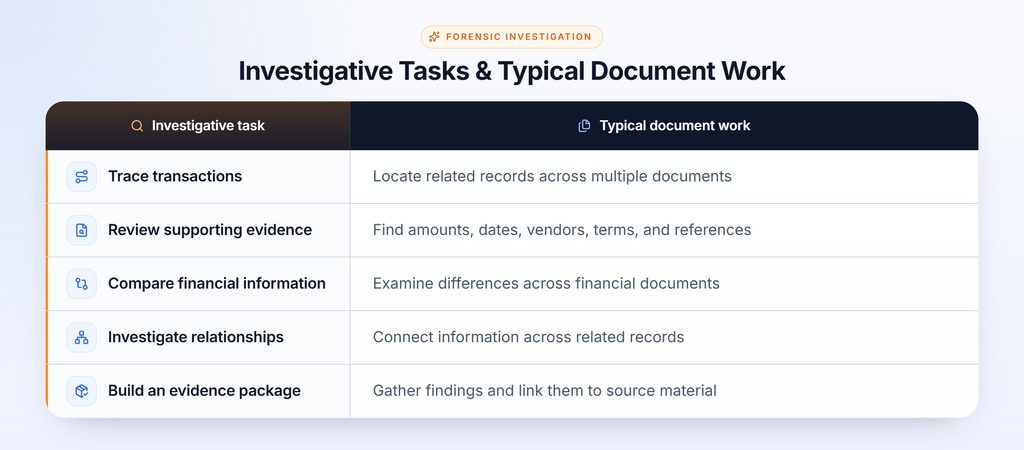
A single transaction rarely tells the complete story. An invoice may show a payment. A purchase order may show what was requested. A contract may establish the agreed terms. An email may explain why the transaction occurred.
Individually, each document provides only part of the picture. Forensic work often involves connecting those records and identifying inconsistencies, relationships, patterns, or timelines. This makes document review different from simply locating a keyword. The goal is to understand how the evidence fits together.
What manual review can require:
Technology Is Becoming Part of Forensic Work
The role of technology in forensic work is expanding. In September 2025, the AICPA Forensic and Litigation Services Forensic Technology Task Force updated the growing use of artificial intelligence, machine learning, robotic process automation, cloud-based analytics, blockchain, and cybersecurity technologies in forensic engagements.
That does not mean technology replaces forensic expertise. It means the tools available to forensic professionals are changing, particularly for work involving large volumes of information.
How OpenParser AI Supports Forensic Workflows
OpenParser AI’s Accounting, Audit & Tax use cases include locating information in prior-year workpapers, extracting invoices and purchase-order data, comparing financial statements, and creating audit-support documentation linked to sources.
For forensic accounting investigations, those capabilities can support several stages of document-heavy review.
- Find information: Ask questions across relevant documents instead of manually searching for one document at a time.
- Extract details: Pull transaction-related fields from invoices, purchase orders, and other records into structured outputs.
- Compare documents: Surface differences across financial statements or related documents for closer examination.
- Connect findings to evidence: Keep findings tied to the underlying source documents so investigators can review and verify the information.
The objective is not to automate professional judgment. It is to make the evidence easier to reach before that judgment is applied.
Reduce the Document Work Behind Every Investigation
See how OpenParser AI can help your team work through financial evidence faster.
Frequently Asked Questions
1. What makes document review difficult in forensic accounting investigations?
Forensic investigations can involve large collections of financial records and supporting documents. Relevant information may be spread across invoices, purchase orders, contracts, workpapers, correspondence, and financial statements.
2. Can AI help forensic accountants review financial documents?
Yes. AI can assist with document search, structured extraction, document comparison, and evidence organization. Professional review and judgment remain necessary.
3. How can AI help connect financial evidence?
AI can identify relevant information across document collections and organize extracted details, helping investigators examine relationships between documents more efficiently.
4. How does OpenParser AI support forensic accounting workflows?
OpenParser AI supports document Q&A, structured extraction, document comparison, and cited evidence workflows that can be adapted to document-intensive forensic accounting activities.