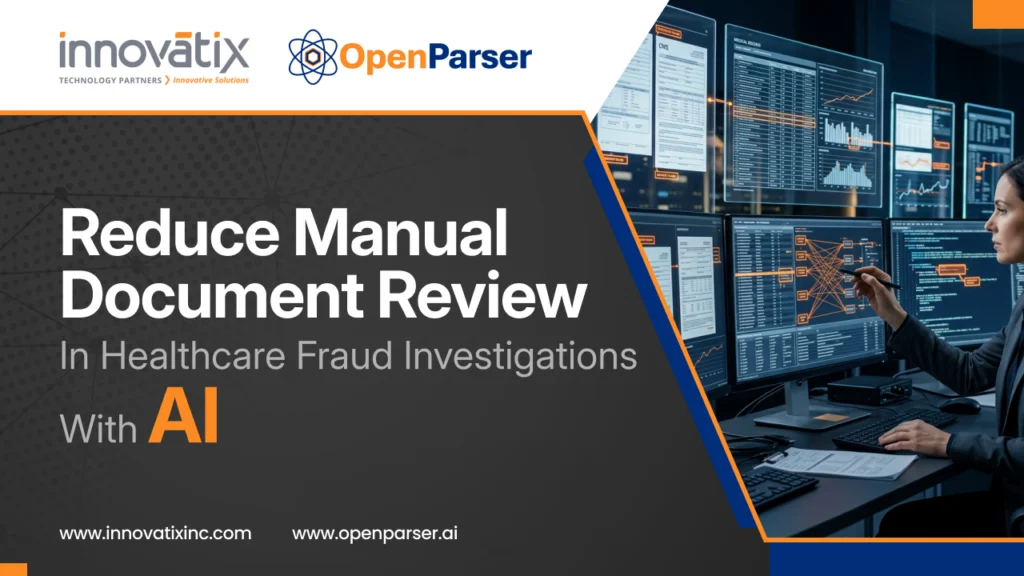
An investigator receives a referral that raises concerns about a healthcare provider’s activities. At first glance, it looks like something might be worth a closer look, but before they can get to the bottom of it, they need to go deeper.
All they have got to start with is some initial information that points to the possibility of something going on. But to get the full picture, they need to start rummaging through a bunch of documents – referral records, clinical documentation, payer agreements, and supporting material to figure out what is going on.
This is where much of the investigative grunt work takes place. It is a laborious process to track down relevant documents, get the relevant details extracted from them, and then check to make sure it all adds up, especially if you are dealing with multiple cases at once. After a while, you start to feel like you are doing the same thing over and over.
AI-powered document intelligence can be of great help for healthcare fraud investigation teams, allowing them to cut down on all the tedious document reviewing work, get all the relevant information in one place, and make it easier to go back and re-check records.
The Document Review Work Behind Healthcare Fraud Investigations
Healthcare fraud investigations can involve several types of documentation. Depending on the case, investigators may need to examine patient referral information, provider records, clinical protocols, payer agreements, internal procedures, and other supporting material.
Each document contributes a different part of the investigation. A referral may establish how a patient entered a particular care process, while a payer agreement describes relevant requirements. Clinical documentation may provide further context for examining the services or procedures under review.
The Department of Health and Human Services Office of Inspector General reported that the Department of Justice opened more than 741 new criminal healthcare fraud investigations during FY2025. The same report recorded more than 448 defendants convicted of healthcare fraud-related crimes during the year. These figures reflect the scale of federal enforcement activity in the United States.
Investigators need reliable supporting material throughout this process. Repeatedly locating information, checking different versions, and organizing findings can add substantial administrative work to an already detailed investigation.
Four Areas Where AI Can Reduce Manual Document Work
AI can assist with document-heavy activities that require investigators to retrieve, extract, and organize information.
AI in Investigations
Where AI supports the investigation workflow
Investigation activity |
Manual work involved |
How AI can assist |
|---|---|---|
01Searching healthcare records |
Manual work involvedLocating relevant information across different documents | How AI can assistAnswer questions about available documents and retrieve supporting passages |
02Extracting patient and referral details |
Manual work involvedCollecting defined information from individual records | How AI can assistOrganize selected information into structured outputs |
03Reviewing policies and procedures |
Manual work involvedComparing documentation against applicable requirements | How AI can assistSurface relevant provisions and potential gaps for further review |
04Comparing updated documents |
Manual work involvedChecking changes across document versions | How AI can assistHighlight differences for investigators to examine |
Finding relevant information: Natural-language document Q&A allows users to ask questions about available records rather than relying entirely on exact keyword searches. An investigator could look for a particular provision in a payer agreement or locate information within a clinical protocol.
Collecting information consistently: Structured extraction can help organize defined details from referral documents and other supporting records. This makes information easier to review across a collection without repeatedly entering the same fields manually.
Checking requirements and changes: AI-assisted comparison can help examine SOPs against specified requirements and identify changes between document versions. Investigators can then determine which differences matter to the case and require further examination.
Keeping Every Finding Connected to Supporting Records
Imagine that an investigator finds inconsistent information across two supporting documents. The discrepancy may be important, but it could also have a legitimate explanation. Before drawing any conclusions, the reviewer needs to inspect the original records and understand why the information differs.
This is why source traceability matters in healthcare investigations. Extracted details and AI-generated answers should be linked to their underlying documents so that investigators can verify the information.
A useful review process should include:
- Source verification: Check whether the cited document supports the extracted information.
- Contextual review: Examine surrounding information rather than relying on an isolated sentence or value.
- Version checks: Confirm whether an updated protocol, agreement, or procedure changes the interpretation of an earlier record.
- Human assessment: Have the responsible investigator evaluate inconsistencies and determine what additional evidence is needed.
Healthcare documentation may also contain sensitive personal information. Organizations should evaluate access permissions, data handling, deployment arrangements, and applicable privacy requirements before introducing AI into an investigative workflow.
How OpenParser AI Supports Healthcare Document Investigation
OpenParser AI is an enterprise document intelligence platform that helps teams search, extract, compare, and organize information across document collections.
For Healthcare & Life Sciences workflows, its capabilities include asking questions across clinical protocols, SOPs, and payer agreements; extracting patient information from referrals; checking SOPs against HIPAA/FDA requirements; comparing clinical protocol amendments; and assembling cited evidence for FDA and EMA submissions.
For healthcare fraud investigators, these capabilities can support the document review surrounding an investigation. Teams can retrieve relevant information, organize defined details, examine changes, and prepare source-linked material for further assessment.
The underlying documents remain essential. Investigators must validate the information, assess the circumstances, and determine whether the evidence supports further action. OpenParser AI assists with document research and organization; it does not independently detect fraud, establish wrongdoing, or replace investigative judgment.
Reduce Manual Document Review &
Organize Records with OpenParser AI
Frequently Asked Questions
1. How can AI help healthcare fraud investigators review documents?
AI can help search document collections, retrieve relevant passages, extract defined information, compare document versions, and organize supporting material for investigation.
2. What healthcare documents can AI help analyze?
Depending on the document collection and configured workflow, this can include referral records, clinical protocols, SOPs, payer agreements, and other supporting documents.
3. Can AI automatically identify healthcare fraud?
AI-powered document intelligence can help retrieve and organize information for investigation. It does not independently establish fraud or determine whether a provider has violated applicable requirements. Those assessments require investigative review and supporting evidence.
4. Why are source citations important in healthcare investigations?
Citations help investigators locate the original document behind an AI-generated answer or extracted detail. This makes it easier to verify information, examine context, and prepare supporting material for further review.