ASC 842 may be an accounting standard, but one of the hardest parts of applying it happens before the accounting begins. The required information often starts inside contracts.
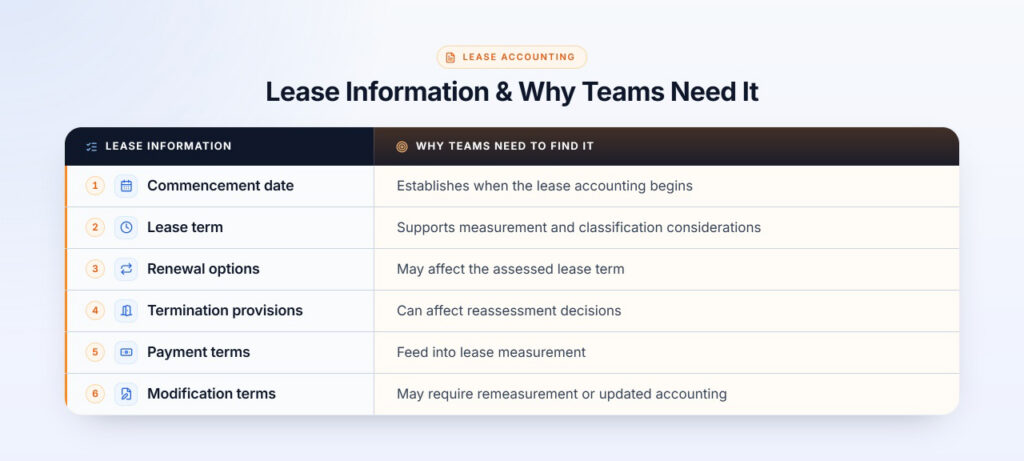
Finance teams are often left scrambling to track down lease commencement dates, payment terms, renewal options, termination clauses, and all the other vital details that will ultimately help them stay compliant with the accounting side of things.
The issue is that this vital information rarely comes neatly packaged in a spreadsheet. No, it is usually buried deep within lease agreements, amendments, addenda, schedules, and any other financial documents.
That makes finding the right lease terms a significant part of the work.
ASC 842 Starts with Contract Information
Under ASC 842, lease accounting requires more than identifying that a lease exists. Teams need to understand the terms that determine how the lease should be accounted for.
For example, the lease term can include the non-cancellable period along with certain extension or termination option periods when the relevant criteria are met. Lease modifications or changes in circumstances can also trigger reassessment. This means a lease document contains information that directly feeds into accounting decisions.
The difficulty is not necessarily knowing what information is needed. It is locating that information consistently across every relevant document.
The Data Is There. It Just Isn’t Structured
This is where lease accounting becomes a document problem. A lease agreement might state a commencement date on one page, describe renewal rights several pages later, and contain a rent schedule in an attachment. An amendment can then change one of those terms without rewriting the original agreement.
For a large lease population, accountants may need to repeat this process contract by contract. A BDO analysis of ASC 842 implementation experience cited a Bloomberg Tax survey of 500 professionals and noted that more than 80% had leases requiring ASC 842 accounting. The same analysis noted that companies may need to collect as many as 100 data fields from each lease. That puts the scale of the extraction challenge into perspective.
Simplify How Your Team Finds ASC 842 Lease Terms
Give your accounting team a faster way to extract and organize information
across lease documents, contracts, and other financial records.
Spreadsheets Still Sit in the Middle
Many teams have responded to this challenge by moving lease information into spreadsheets or specialized lease-accounting systems. But the underlying extraction problem still exists: someone has to get contractual information into the system.
A 2025 market survey conducted by Kantar for Quadrent included 260 decision-makers responsible for technology purchasing or IFRS 16/AASB 16 compliance. The survey found that 26% still used Excel or other spreadsheet software, while 37% used dedicated lease-accounting software.
This was an IFRS 16/AASB 16 survey rather than an ASC 842-only study, but it highlights a broader lease-accounting reality: spreadsheets and manual processes remain part of the workflow for a meaningful share of organizations.
That creates a familiar cycle: Read the contract → locate the term → copy the information → check it → enter it into the accounting workflow. In other words, the accounting system may be automated. The document reading that feeds it may not be.
The Real Challenge Is Often the First Read
The most time-consuming step can happen before a lease reaches the accounting platform.
Consider a portfolio containing real estate, equipment, vehicles, or other leased assets. The contracts may use different structures and terminology. Some may have amendments. Others may include renewal options or clauses that require closer interpretation.
A manual process forces accountants to repeatedly answer questions such as:
- Where is the commencement date?
- What is the stated lease term?
- Are there renewal or termination options?
- What payment terms are specified?
- Has the original agreement been amended?
- Which document contains the latest information?
The challenge increases when these questions must be answered across hundreds of agreements. This is where AI can be useful without taking over the accounting judgment. Instead of asking an accountant to locate every relevant term manually, AI can process lease documents and extract the information into a structured format for review.
That distinction matters. AI does not need to decide the accounting treatment to create value. It can first help answer a simpler operational question: “What does the contract actually say?” From there, accounting professionals can review the extracted terms, apply the appropriate ASC 842 guidance, and make the required judgments.
The OpenParser AI Advantage for Modern Workflows
OpenParser AI can support this first stage by extracting structured information from lease documents and other financial documents.
For Accounting, Audit & Tax workflows, its use-case framework specifically includes extracting ASC 842 lease terms alongside invoice and purchase-order data. That means teams can use OpenParser AI to help turn information buried in contracts into a structured, reviewable output rather than manually searching every document.
The value is especially relevant when lease information is distributed across a large document collection. Instead of treating every contract as a fresh reading exercise, teams can use AI to surface the terms they need and apply accounting expertise where it matters.
Use AI to Surface the Terms. Keep Accounting Judgment with the Experts.
OpenParser AI can help teams extract lease information and organize it for review, giving accounting professionals a more efficient starting point for ASC 842 workflows.
Frequently Asked Questions
1. What lease terms are important under ASC 842?
Key information can include the lease term, commencement date, payment terms, renewal and termination options, and other contractual details that affect lease accounting.
2. Why is finding ASC 842 lease information difficult?
Lease information can be spread across contracts, amendments, schedules, and attachments, making manual extraction time-consuming and inconsistent across large portfolios.
3. Can AI extract ASC 842 lease terms?
Yes. AI can help identify and structure contractual information from lease documents. The accounting team still needs to review the extracted information and apply the relevant accounting guidance.
4. How can OpenParser AI help with lease accounting workflows?
OpenParser AI can extract ASC 842-related lease terms from financial documents and organize the information into structured outputs for review.