A real estate title review is never just a matter of finding one document; it is about piecing together the puzzle of how all the different pieces of the property’s history fit together – deeds, mortgages, liens, easements, releases, ownership records, and all the other supporting documents that need to be connected to get a clear picture of whether a property can move toward closing.
This creates a document-heavy workflow for title agents to manage; even when records are stored digitally, sifting through everything is still a major undertaking.
A March 2026 study from the American Land Title Association (ALTA), based on 449 industry responses across 47 states, found that a whopping 61% of purchase deals involved reviewing 11 to 50 documents, while another 21% involved more than 50 documents.
In simple terms, the more records a title professional must connect, the more valuable a fast, reliable document search becomes.
Title Review Is a Document-Connection Problem
A title search can surface the records. The harder task often begins afterward. A title professional may need to determine whether the current ownership record aligns with earlier deeds, whether a mortgage was properly released, whether an easement affects the property, or whether a lien still requires attention.
That means repeatedly moving between documents, searching for names and dates, checking legal descriptions, and comparing related records. The problem is not simply document volume. It is the relationship between documents.
ALTA’s research highlights this clearly. Ownership and mortgage records were the most difficult documents to review for 24.2% of respondents, followed closely by easements at 23.6%. For title teams, a better document workflow should therefore do more than locate keywords. It should help surface relevant information and make the source easy to verify.
Where Manual Review Creates Delays
Search the Entire Title File with Natural-Language Questions
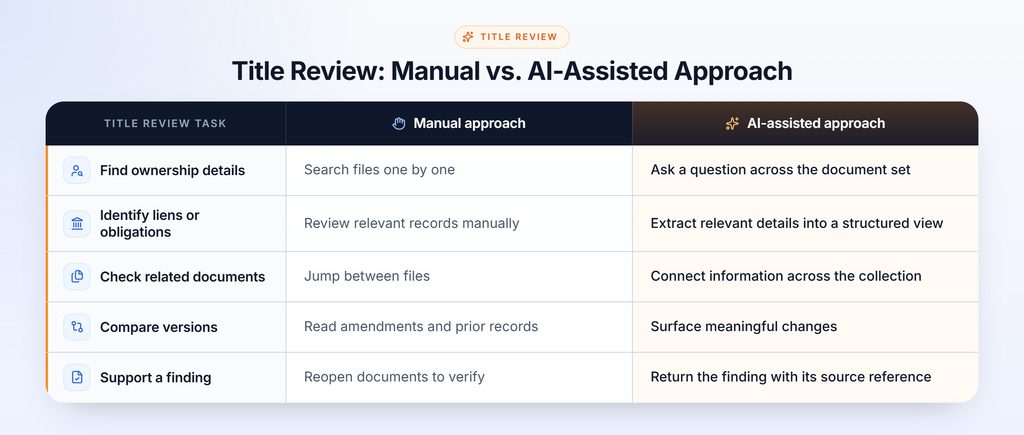
Traditional document search depends heavily on knowing what to look for. AI-powered document search changes that interaction. Instead of searching for an exact phrase, a title professional can ask a question in plain language and retrieve relevant information from the available document collection.
For example: “What recorded documents indicate an outstanding mortgage or lien on this property?” Or: “Which document establishes the current ownership, and what earlier record supports the chain?”
The value comes from connecting the answer back to the source. As a quick note, OpenParser AI is designed around citation-backed document Q&A, where answers are grounded in the underlying documents rather than presented as unsupported summaries. Its broader workflow also combines document Q&A with AI-agent-based processing.
Convert Large Document Sets into Structured Information
Search is only one part of the problem. When a title operation handles multiple files, manually transferring information into spreadsheets or review templates can create another layer of repetitive work.
OpenParser AI’s bulk structured data extraction capability can be applied to document collections to pull defined information into a consistent format. For a title workflow, that could mean organizing ownership details, recording dates, parties, document types, obligations, or other fields required for review.
This matters because structured information is easier to compare, filter, and review than a folder full of PDFs. It also creates a more repeatable process for teams handling higher transaction volumes.
Keep Every Finding Connected to Its Source
Speed matters in title work, but traceability matters just as much. A title review finding may eventually influence underwriting, curative work, communication with stakeholders, or closing preparation. That makes it important to know where the information came from.
OpenParser AI’s evidence assembly and cited reporting capability is designed to gather relevant information from a document collection and produce structured outputs linked back to source material. The result is a review process where information is easier to retrieve, organize, and verify.
Summing Up
Title review will always require professional judgment. AI does not change that. What it can change is how much manual document work happens before that expertise is applied.
With AI-powered document search, structured extraction, comparison, and source-linked outputs, title teams can reduce repetitive searching and build a workflow that makes information easier to reach and verify.
For an industry where more than one in five purchase transactions involve over 50 documents, improving document access is not a minor productivity gain. It can become a meaningful part of building a faster and more consistent title review process.
Build a Smarter Real Estate Title Review Workflow
Bring faster document search and source-backed review into every workflow with OpenParser AI.
Frequently Asked Questions
1. Can AI replace a title professional’s review?
No. AI should support the review process by helping locate, extract, compare, and organize information. Final interpretation and title decisions should remain with qualified professionals.
2. Can OpenParser AI search across multiple title documents?
Yes. OpenParser is designed for document collections, allowing users to ask questions across available documents and receive answers grounded in the underlying sources.
3. How does citation-backed search improve title review?
It allows reviewers to move from an AI-generated answer back to the underlying source, making it easier to verify the information before relying on it in the review process.