A construction project can generate a remarkable amount of paperwork. You have got RFIs, submittals, contracts, specifications, drawings, change orders, inspection records, invoices, safety documents, and project reports all piling up with the kind of information that team needs to track down, double-check, compare and reuse somewhere down the line.
Now, it is not like the information is hard to find. It is just that people end up spending way too much time moving bits of data from one document to another, searching for the right section, comparing versions, and answering questions that a team member probably already documented somewhere a long time ago.
That is where AI Agents for construction industry can step in and give the team a break. Rather than just using AI to generate text on demand, one can use these agents to automate a bunch of routine document tasks and do it across large sets of project information.
Construction Already Runs on Digital Information
Construction companies have adopted project management, BIM, document management, and other digital tools. Yet the information itself is still frequently handled through spreadsheets and separate documents.
Autodesk’s 2025 Spotlight on Construction found that 35% of respondents identified spreadsheets as the digital tool they use for construction, ahead of several specialized technologies. The same research found that only 32% of construction leaders said their organizations were approaching or had achieved their AI goals.
This points to an important gap. Digitizing a document does not automatically automate the work surrounding it.
Repetitive Document Tasks Add Up
Consider a project team handling a steady stream of RFIs.
A question may require someone to open drawings, check specifications, review an earlier document, locate the relevant clause, and prepare a response.
Autodesk research found that 73% of respondents were logging RFIs and responses on more than half of their projects, but only 30% were comparing RFI data from past projects.
The information is being captured. The next step is making that information usable.
The same pattern appears elsewhere:
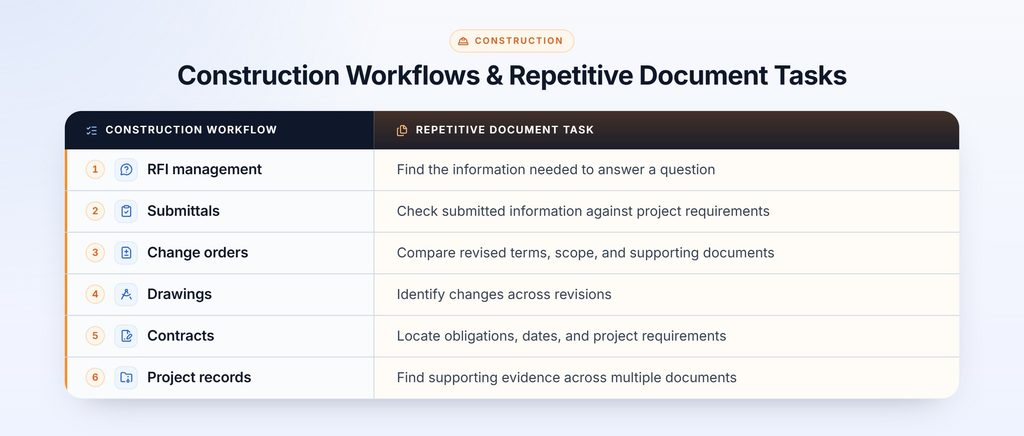
These tasks may look small individually. Across a large project portfolio, they become a significant administrative workload.
AI Agents Change the Task, Not Just the Speed
A conventional search tool helps you locate a document. An AI Agent can be used to perform a defined task across documents. That distinction matters.
A construction team could create a workflow where an agent reviews a set of project documents and extracts specified information. Another workflow could compare two document versions and identify changes. A separate agent could answer questions about specifications and point users to the relevant source. The goal is not to remove people from the process. It is to remove repetitive steps from the process.
Automate the Repetitive Work Behind Your Project Documents
Use OpenParser AI to search, extract, compare, and organize
information across construction documents.
Where AI Agents Can Help Construction Teams
1. Finding Answers Across Project Documents
Project teams often know the answer exists somewhere. The challenge is locating it quickly.
An AI Agent can help users ask questions in plain language across relevant documents rather than manually searching individual files.
For example: “What does the specification require for this material?”
The important part is not only receiving an answer. The source should remain available so the team can check the supporting information.
2. Extracting Information from Large Document Sets
Construction documents contain structured information in unstructured formats.
An AI agent can extract items such as:
- Contract dates and obligations
- Project requirements
- Material details
- Cost information
- Key fields from forms and reports
- Information from supporting project records
Instead of repeatedly copying information into spreadsheets, teams can start with a structured output and review what matters.
3. Comparing Versions
Projects change constantly. Specifications are revised. Drawings are updated. Contract documents are amended. A manual comparison can require careful page-by-page review.
An AI Agent can compare document versions and surface changes so project teams can focus on the differences that require attention.
4. Checking Requirements
Another repetitive task is checking one document against another.
A submittal may need to be reviewed against a specification. A project document may need to be checked against a defined requirement or standard.
AI can perform the first comparison and highlight areas that need human review. This is particularly useful because construction leaders are still working through the practical question of where AI delivers real value.
OpenParser AI and Construction Document Work
OpenParser AI is built around several document workflows that can be adapted to construction use cases: citation-backed Q&A, structured data extraction, compliance and policy checking, document comparison, and evidence assembly.
For a construction team, that can mean asking questions across project documents, extracting project information into structured outputs, comparing revisions, or locating supporting evidence without manually opening every document.
The AI Agent performs the repeatable first pass. The project team reviews the result and applies the judgment needed for the situation.
That division of work is important. Construction does not need AI making every decision. It needs AI handling more of the searching, extracting, comparing, and organizing that happens before a decision is made.
Automate the Repetitive Work Behind Your Project Documents
Use OpenParser AI to search, extract, compare, and organize
information across construction documents.
Frequently Asked Questions
1. What are AI Agents in construction?
AI Agents are systems designed to perform defined tasks across project information, such as finding information, extracting data, comparing documents, or checking requirements.
2. Which construction documents can AI Agents work with?
Depending on the workflow, AI can work across documents such as contracts, specifications, drawings, RFIs, submittals, change orders, reports, and other project records.
3. Can AI replace construction professionals?
No. AI Agents can automate repetitive document tasks, while construction professionals continue to review outputs, apply project context, and make final decisions.