
“Can you check if there is a termination for convenience clause in this agreement?” It seems like a simple request. However, it is not always easy to find the right answer.
A lawyer opens the agreement and starts digging. They look for termination and get a whole bunch of results back. But the one that comes up is all about Breaches/Notice Periods. Then just when you think you have got it, an amendment comes along and changes all that.
Even Thomson Reuters says legal professionals spend 40-60% of their time drafting up legal documents and reviewing contracts. Time that could be better spent with clients, determining potential risks, or gathering actual strategic input into business decisions.
The challenge intensifies during the due diligence process, compliance checks, or in large contract negotiations. Legal teams are called upon to respond to difficult queries, like:
- What is the deal with termination clauses?
- Are there any updates or changes to the liability clause?
- Which contracts are going to automatically roll over to next quarter?
- Is there some clause that kicks in if control of the company changes hands?
The answers are all hiding in plain sight within those contracts. The hard part is discovering them quickly and making 100% sure they are up to date and accurate.
This is why AI contract review is increasingly becoming an integral part of law firms’ operations today. It is not about replacing lawyers it is about providing them with the right tools to locate the information they need sooner, freeing them up to spend more time analyzing the legal details and less time searching through contracts.
Experience a Faster Way to Review Legal Documents
See how OpenParser AI helps legal teams find critical clauses, verify answers with page-level citations and simplify document-intensive workflows.
Why Finding Critical Clauses Takes Longer Than It Should
Basically, legal contracts are written to lay out the terms of a business relationship, not to get the answers you need in a split second.
Take a typical due diligence process – for example, let’s say a legal team has to dig through hundreds of contracts with suppliers, customers and vendors within a tight deadline. Before they can even start to assess the risks, they have got to track down all the clauses that might be critical, such as:
- Assignment rights
- Liability caps
- Termination provisions
- Governing law
- Indemnity obligations
- Renewal terms
Even experienced lawyers don’t have the luxury of typing a few keywords into search and walking away.
Sometimes a clause in an agreement refers to another section. An amendment to an agreement may override the original language. This means there can be multiple versions of what is supposed to be a single agreement floating around.
As a result, legal professionals are forever stuck wading through contract after contract, just trying to get their hands on the information they need before they can even begin reading it properly.
It is not just the legal team that suffers, delays in contract review can slow procurement, postpone sales negotiations and extend transaction timelines.
The blockage isn’t legal expertise. It is getting the information to hand.
Only once lawyers can get hold of the right contract, does the analysis begin. Trouble is, tracking down that one right bit of text is often the part that takes up most of their time.
Legal teams ask themselves these kinds of questions all the time
- Can this contract be passed on to someone else?
- What exactly are the terms for getting out of this contract?
- Has there been a change in the liability clause?
- Which of these contracts is going to be renewed next quarter?
- Does this contract comply with our in-house legal rules?
How AI Changes Clause Discovery Without Replacing Legal Judgment
Legal professionals don’t need AI to interpret contracts for them. They need a way to get to the useful information a whole lot faster.
Imagine a procurement team asking: “Can you assign this supplier agreement once we have bought the company out?” The way it is usually done is a lawyer would open the agreement, scan through loads of different sections, try to make sense of any amendments, and then double check the latest version before answering.
Modern AI-powered contract scanning tools change that workflow.
Instead of having to trawl through every page, lawyers can just ask a question in their own words and be taken straight to the relevant clause. They still have to review the language, interpret the legal implications, and make the final call, but now they don’t have to waste time searching through all that paperwork.
This shift really shows just how legal teams are already embracing AI. According to Thomson Reuters, document drafting and contract review continue to be huge burdens for legal professionals, making this a prime area for AI-powered workflows to bring some real help.
OpenParser AI takes a very grounded approach to this.
Instead of just serving up answers based on general knowledge, it digs through your company’s actual contracts and legal documents. Every single response is backed up by page-level citations, so you can easily check the source document.
If the information you requested just isn’t in the document, the platform says so instead of generating an unsupported answer. And that fits right in line with OpenParser’s “lawyers first” philosophy of helping with the preliminary review but leaving the actual legal interpretation to the experts.
How Legal Teams Use AI Beyond Clause Discovery
It is one thing to track down crucial clause; the real work in legal is just getting started from there. With all the relevant information at their fingertips, legal teams still need to compare documents, check compliance, and put together the supporting evidence to make their case.
That is where document intelligence really comes into its own. Rather than being a one-trick solution that just solves a single problem, OpenParser AI supports several key legal workflows right across the contract life cycle.
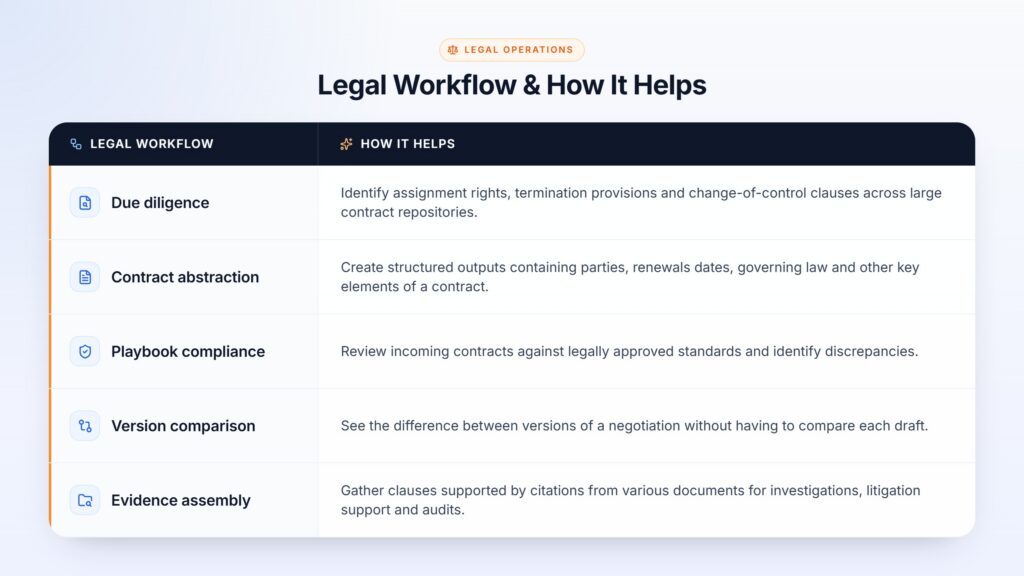
These workflows can cut down on tedious document handling and let legal teams work with greater speed and consistency. But more than that, they free up lawyers to focus their skills on where they really add most value i.e., evaluating legal risk, negotiating better outcomes and advising the business.
Key Takeaways
Before deciding on an AI solution for your legal needs, ask yourself these questions:
- Does every answer link back to the actual document you are looking at?
- Can you easily check how a particular clause is supported by the contract?
- Can it handle contracts in bulk, or is it one document at a time?
- Will it be able to help you with due diligence, compliance checks, and comparing contracts?
- Does it work with lawyers, or is it going to take over and make decisions on their behalf?
If you find yourself saying yes to all those things, you are probably looking at a solution that can genuinely help streamline the legal process without losing trust in the process.
Wrapping Up
With the number of contracts just continuing to increase, the old approach of sticking your hands through a contract to find a piece of information is not feasible anymore.
That’s where AI-powered document intelligence makes a meaningful difference.
OpenParser AI empowers legal teams to pose queries throughout contracts, pinpoint essential clauses, and confirm all responses with page-level citations that refer to the original document. Moreover, its embedded AI Agent takes it one step further by comprehending the context of whole sets of documents and providing answers that are rooted in the source material.
Beyond clause discovery, OpenParser AI also supports with due diligence, contract abstraction and making sure you are playing by the compliance rules. There is also the contract comparison feature, allowing you to effortlessly witness variations in between different versions of a document over time.
OpenParser AI really does make it a whole lot easier to complete document-intensive work and keep lawyers in charge of making tough calls.
Experience a Faster Way to Review Legal Documents
See how OpenParser AI helps legal teams find critical clauses, verify answers with page-level citations and simplify document-intensive workflows.
Frequently Asked Questions
1. Is it possible for AI to replace lawyers when reviewing contracts?
No way, AI is designed to give lawyers a helping hand, not replace them. It can quickly find relevant clauses, pull all the relevant information together and do the initial scan of a contract in no time. However, interpreting words in a contract, assessing risks and providing legal advice is still 100% down to qualified legal professionals.
2. How does OpenParser AI save lawyers so much time on contract reviews?
Rather than manually searching through lengthy agreements, OpenParser AI lets your legal team ask questions in plain language and receive citation-backed answers from their own documents. This means lawyers can find the critical information they need a lot faster and still see exactly where the answers came from.
3. Is it just finding clauses that OpenParser AI can help with then?
No, it is much more than that. Beyond finding critical clauses you really care about, OpenParser AI supports legal workflows such as due diligence, contract abstraction, playbook compliance, version comparison and evidence assembly. This means legal teams can process a lot of documents much faster throughout the entire lifecycle of a contract.
4. Why do citation-backed answers matter so much in legal work?
In the process of reaching a decision, lawyers must rely on the accuracy of the information. With citation-backed answers, lawyers can go back to the original contract and check that the answer matches up, so they can be confident in what they are doing without having to worry about whether AI just made something up.
5. What kinds of legal documents can OpenParser AI help with?
OpenParser AI can work with a whole load of different legal documents, from contracts to Master Service Agreements (MSAs), Non-Disclosure Agreements (NDAs) and all sorts of other paperwork that is heavy on words and thin on results. It lets your team search across all these documents in one place, bring what they need to the surface and verify the information to make sure it is all spot on.